
CFJ's Mujahideen Muhammad Co-Authors Times Union Op-ed
Commentary: For the incarcerated, a path to a second chance. The Second Look Act aligns with the tenets of our faith. It would strengthen New York's communities, too.
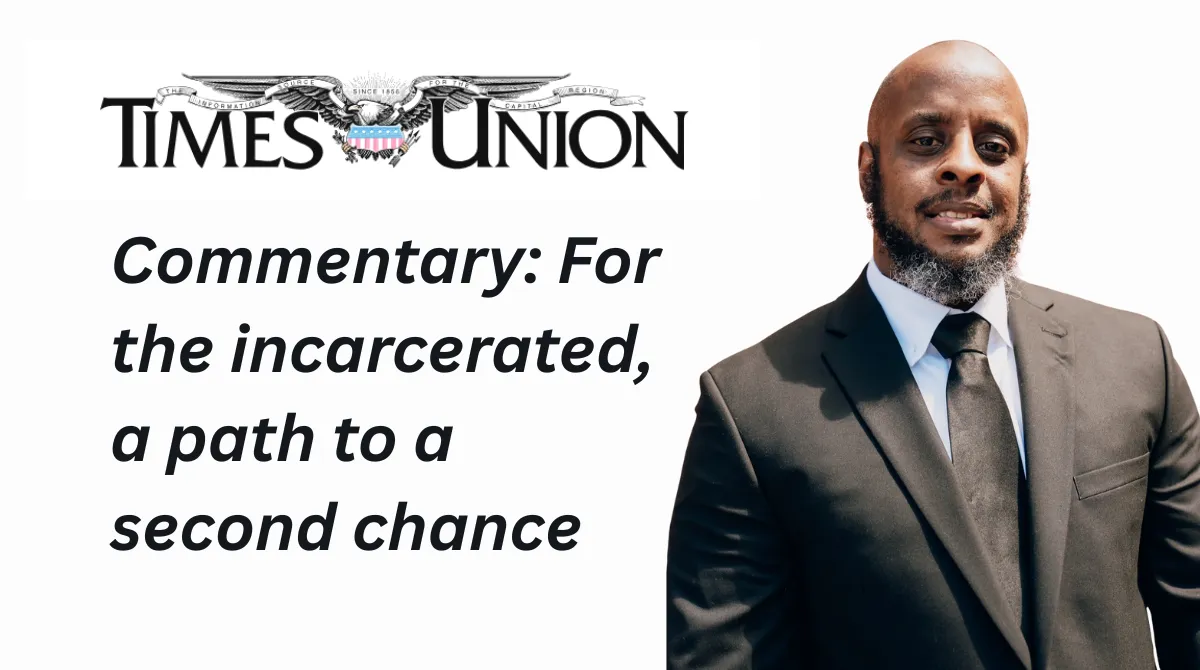
Commentary: For the incarcerated, a path to a second chance
The Second Look Act aligns with the tenets of our faith. It would strengthen New York's communities, too.
Jan 4, 2026
Originally published in Times Union
State prisons are plagued by chaos, staff shortages, and the inhumane treatment of incarcerated people. But there’s another way.
One of us was incarcerated for 24 years and now leads a nonprofit dedicated to strengthening local communities. The other leads a seminary that offers a master’s degree in education to New Yorkers behind bars.
Both as community leaders and as people of faith who have witnessed the injustices of mass incarceration, we know that second chances make New York stronger. When the legislative session starts, lawmakers should pass the Second Look Act, which would enable people serving extreme sentences to receive an opportunity for an earlier release.
Take it from us, two people with extensive but vastly different experiences with the criminal legal system: The Second Look Act can make prisons safer — and strengthen local communities.
One of us learned that from behind prison walls. I, Mujahideen, was sentenced to 25 years to life when I was just 19 years old. I was raised in a family that struggled with drug addiction and mental illness, and I developed a conduct disorder. While in prison, I took a hard look at my life. Like so many incarcerated people, I decided that I wanted to rejoin the outside world with the skills and tools to be a helpful, productive member of my community. So I poured myself into education and my Muslim faith.
In 2024, thanks to a landmark program for incarcerated people started by the New York Theological Seminary, I received my master of professional studies degree in ministry and leadership. When I left prison, the Center for Justice at Columbia University hired me as a research assistant and asked me to write a report about second-look legislation. I also co-founded The Pillars of Promise, which brings together previously incarcerated people who are dedicated to making positive contributions to communities.
The other of us, Serene Jones, has been a staunch advocate for criminal legal reform. As a faith leader, I believe that we have a moral duty, grounded in the teachings of the Bible, to support marginalized communities that have been targeted by mass incarceration, and to give them the opportunity to flourish.
As president of New York City’s Union Theological Seminary, which now hosts the Master of Professional Studies Program, I know that rehabilitative and educational programs can provide people with the tools they need to thrive. And as a longtime New Yorker, I have seen how extreme sentences have needlessly torn communities apart, particularly among people of color, and created pervasive trauma that echoes through generations.
Several states have recognized the need for second chances and implemented second-look legislation. Unfortunately, there is skepticism of such reforms here in New York. Some argue that releasing people early is dangerous. But research says the opposite. Study after study shows that people who receive second chances are incredibly unlikely to reoffend. In fact, they can actually reduce crime. Many freed people provide mentorship and guidance to people who might be at risk of committing crimes, particularly younger people.
Additionally, second-look legislation does not provide a “get out of jail free” card. New York’s Second Look Act would offer people who have been sentenced to at least a decade in prison the chance — not a guarantee — to get a reduced sentence. Incarcerated people must demonstrate the steps they have taken to merit a shorter sentence, and then a judge must carefully evaluate their case.
Skeptics also argue that reducing sentences dishonors the victim of the crime and their loved ones. Of course, we must carefully consider the experiences and feelings of those impacted by a crime. But a growing body of research shows that rehabilitative measures can be quite restorative for victims. When incarcerated people demonstrate how they have sought to change and make amends, it can provide a much-needed sense of peace and closure.
As people of faith — as many in New York are — we know second-look legislation also aligns with our deepest values. Virtually every faith tradition tells us to care for poor and marginalized communities — communities that are disproportionately targeted by incarceration. And both of our traditions, Islam and Christianity, call on us to exercise forgiveness.
In the Quran, for example, the Prophet Moses kills an Egyptian who was beating a man. He expresses remorse for his actions and begs for forgiveness. God then shows him mercy and forgiveness and selects him later to serve a special purpose. Meanwhile, in the Bible, Hebrews 13:1-3 states, “Continue to remember those in prison as if you were together with them in prison, and those who are mistreated as if you yourselves were suffering.”
With the Second Look Act, we could reduce our prison population and help alleviate the myriad of issues plaguing our prisons. And the New Yorkers we return to their communities will help strengthen them. When the opportunity to consider this legislation arises again in 2026, we must seize it.
Mujahideen Muhammad is an alumnus of Union Theological Seminary's MPS program, a research assistant at Columbia University Center for Justice, and the co-founder and leader of The Pillars of Promise. The Rev. Dr. Serene Jones is president of Union Theological Seminary in Manhattan.